
Archives
-
Vol. 1 No. 1 (2022)
This issue of the International Journal of Economics and Society presents a selection of research articles covering a wide range of topics in economics, management, history, and political science. The contributions explore methodological approaches to state and management development, the influence of oil resource abundance on investment in Nigeria, and the traditions of peasant self-government during the modernization processes. Further studies examine the establishment of Azerbaijan–US political relations in the 1990s, as well as theoretical and practical aspects of assessing and enhancing the economic potential of enterprises. Together, the articles highlight contemporary challenges in economic analysis, governance, and international relations, offering both historical perspectives and forward-looking strategies.
-
Vol. 3 No. 1 (2024)
This issue of the International Journal of Economics and Society brings together a diverse range of scholarly contributions that address pressing challenges in economics, politics, social sciences, and cultural studies. The articles examine the resilience and security of industrial enterprises, the influence of media technologies on political communication, and the evolution of scientific approaches to spirituality. Key themes also include government policies supporting Ukraine’s agricultural sector, mechanisms of financial support for innovation, and opportunities arising from valuation biases in financial markets.
Further contributions analyze coordinated community responses to intimate partner violence, gendered dynamics in sex education policymaking, and the macroeconomic implications of remittance inflows in Nigeria. Together, these studies highlight both theoretical and applied dimensions of contemporary global issues, offering insights into economic security, innovation financing, behavioral finance, public policy, social accountability, and cultural development.
This volume provides academics, policymakers, and practitioners with evidence-based research and conceptual frameworks to better understand the interplay between economic systems, governance, and societal transformation in today’s interconnected world.
-

Vol. 3 No. 2 (2024)
This issue of the International Journal of Economics and Society presents a diverse collection of research articles exploring pressing questions in economics, philosophy, education, and social sciences across multiple regions of the world.
The edition opens with an analysis of political aspects of Azerbaijan’s state strategy for educational development, emphasizing human capital modernization and alignment with European standards. A study on tax control in Ukraine examines current methods of implementation and proposes improvements in line with European integration. Continuing the economic perspective, a paper on non-oil exports and economic growth in Nigeria provides an econometric evaluation of trade dynamics and industrial development.Regional economic development is further explored in a contribution addressing the disparities and strategic models of Ukraine’s regions, while another article investigates the impact of credit spread fluctuations on portfolio value, applying Monte Carlo simulations to assess risk and capital requirements.
Philosophical inquiry is represented through two contributions: one offering a comprehensive review of the philosophy of science with special consideration of behaviorism, and another tracing the concept of causality from Hume to modern science, linking classical theories to contemporary debates.From a social science perspective, the issue features a study on how social workers demonstrate respect for elderly clients, identifying and categorizing forms of respect that can enrich professional practice and cultural understanding.
Together, these works highlight the journal’s mission to integrate economic analysis with philosophical reflection and social inquiry, providing readers with both theoretical insights and practical implications for policy, governance, and professional practice in an interconnected world. -
Vol. 2 No. 1 (2023)
This issue of the International Journal of Economics and Society presents a cross-disciplinary collection spanning intellectual history, economic education, innovation management, media philosophy, international trade, and human capital. It opens with a study of the Khorezm scholar Mahmud al-Zamakhshari, mapping his enduring contributions to linguistics, lexicography, and Islamic studies across a broad corpus. Advancing the pedagogy of economics, the issue proposes diagnostic criteria and methods for assessing students’ professional and terminological competence. An article on innovation outlines a staged, process-oriented framework for transforming novelties into marketable products and identifying inter-sector opportunities. A philosophical inquiry into mediaspace examines how aesthetic media shape, transmit, and transform cultural meanings within contemporary virtual environments. Turning to international economics, a data-informed review of Ukraine–China partnership analyzes current trade dynamics, flagship projects, and future prospects. Finally, the theoretical and methodological foundations of human capital in the information society are clarified, distinguishing adjacent concepts and discussing the effectiveness of investment in skills and capabilities. Together, these contributions illuminate how knowledge, competencies, technology, and global partnerships interact to drive socioeconomic development.
-
Vol. 4 No. 1 (2025)
This issue of the International Journal of Economics and Society brings together diverse research that explores pressing themes in socio-economic development, cultural policy, and global integration. The articles included in this volume present both empirical and theoretical perspectives across a wide range of regions and disciplines.
The issue opens with a comprehensive study of sustainability indicators in Azerbaijan, applying multi-dimensional statistical methods to evaluate economic growth and socio-economic dynamics. Regional development and convergence processes are further examined through an analysis of interregional disparities in South Korea’s innovation-driven economy. Questions of social transformation are also reflected in research on socio-economic exclusion in contemporary societies, offering a conceptual and methodological framework for measuring exclusion and its consequences.
Historical perspectives are provided through a study of the interaction between socio-political organizations and authorities in the Ukrainian provinces of the Russian Empire (1905–1917), highlighting the role of various types of sources in reconstructing social and political dynamics. Cultural policy is addressed in an article on multiculturalism in Azerbaijan, with an emphasis on education, law, and legislation.
In addition, the volume features research on the socio-economic determinants of academic performance in Nigeria, identifying the key household and infrastructural factors that shape educational outcomes. Finally, the issue explores the intersections of orientalism, islamophobia, and integration processes, focusing on the challenges faced by Muslim communities in Western societies.
Together, these contributions provide valuable insights into the complexity of economic, social, and cultural transformations across different contexts, underscoring the interconnectedness of development processes in a globalized world.
-
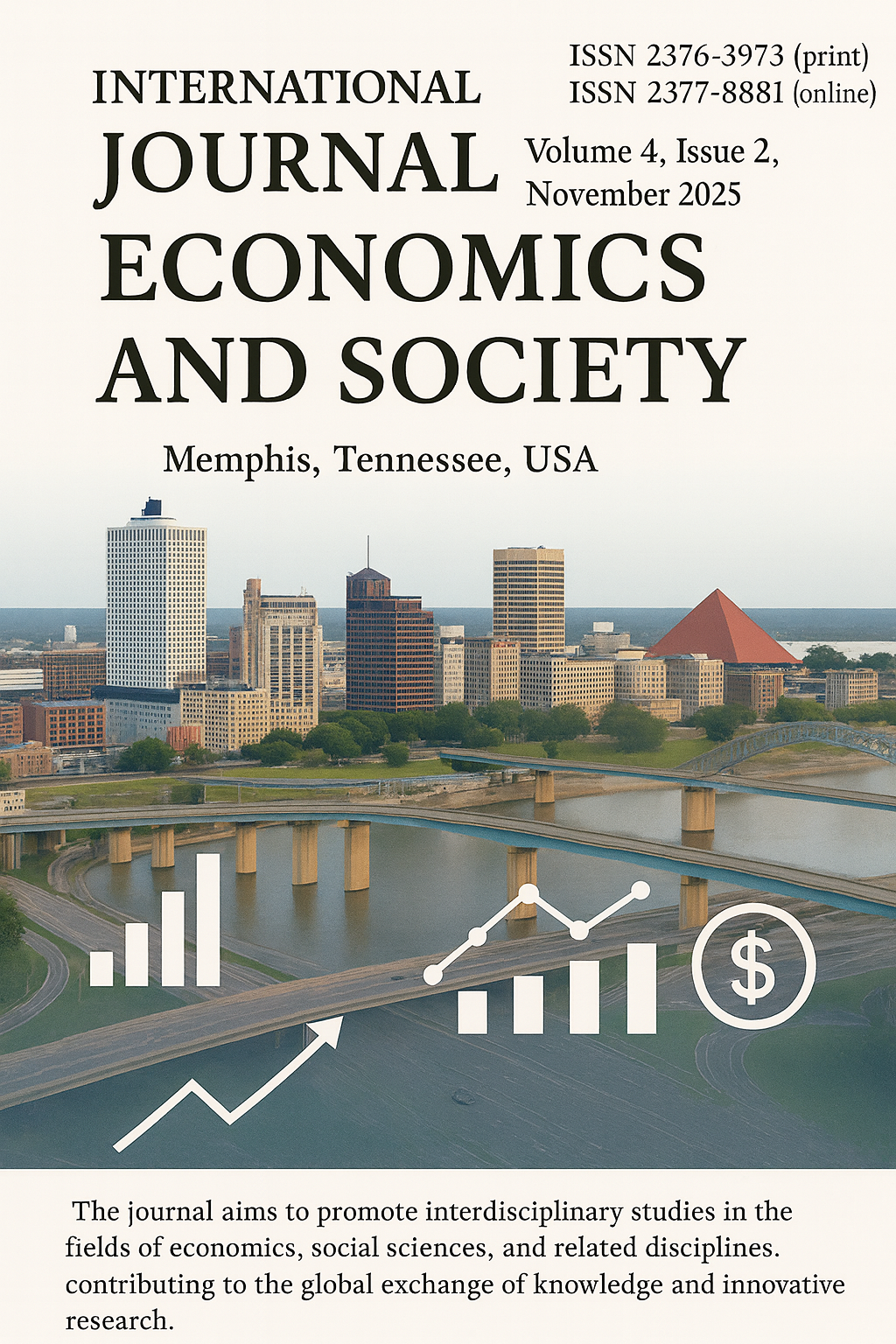
Vol. 4 No. 2 (2025)
This issue of the International Journal of Economics and Society features a collection of scholarly works addressing key challenges in socio-economic development, cultural policy, and global integration. The articles combine empirical evidence with theoretical analysis, covering a broad spectrum of regions and academic perspectives.
Collectively, these studies offer meaningful insights into the multifaceted nature of economic, social, and cultural change, highlighting the interdependence of development processes within an increasingly globalized environment.